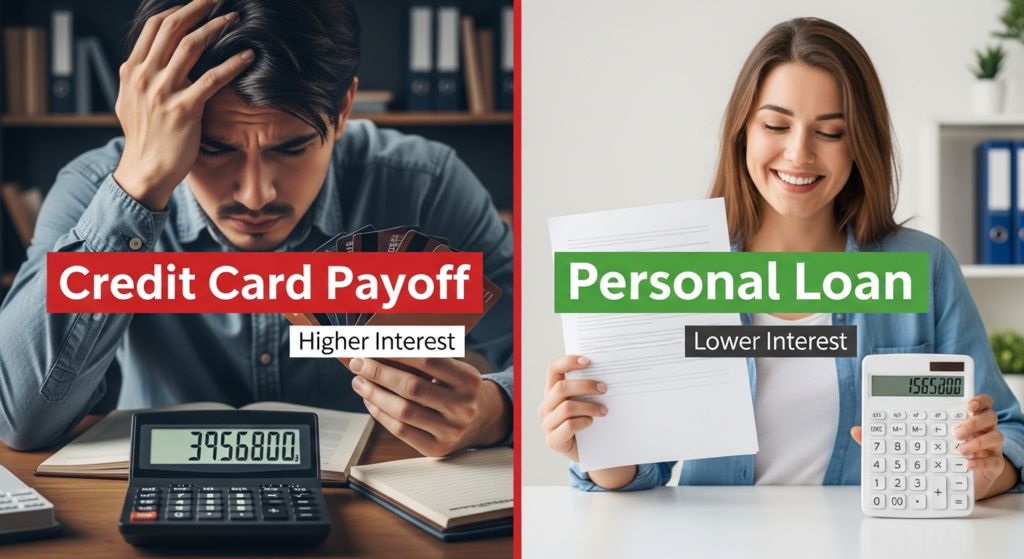
Why This Decision Matters
If you are carrying credit card debt, you have probably asked yourself whether it is better to keep paying the card slowly or take a personal loan to clear it. This decision can easily save or cost you thousands in interest, depending on how you handle it.
Credit cards charge very high interest, often silently. Personal loans, on the other hand, come with fixed EMIs and lower interest rates. Choosing the wrong option can keep you stuck in debt for years, while the right choice can help you become debt-free much faster.
This guide explains the difference between credit card payoff and personal loan consolidation, how interest actually works, and when each option makes sense. By the end, you will be able to decide confidently using logic instead of fear.
Understanding Credit Card Debt
Credit cards are designed for convenience, not long-term borrowing. Most credit cards charge extremely high annual interest rates, often above 30 percent. The biggest danger is that interest is calculated daily and compounded monthly.
When you pay only the minimum amount due, most of your payment goes toward interest, not principal. This is why balances seem to never reduce even after years of payments.
Credit card debt feels flexible, but this flexibility is what traps many people.
Credit Card vs Personal Loan Calculator
How Personal Loans Work for Debt Payoff
A personal loan used for credit card payoff is often called debt consolidation. You take one loan, clear the card balance fully, and then repay the loan through fixed monthly EMIs.
Personal loans usually have much lower interest rates compared to credit cards. They also have a fixed tenure, which means your debt has a clear end date.
The biggest advantage of a personal loan is predictability. You know exactly when the debt will end.
Interest Rate Comparison: The Real Cost Difference
Credit cards typically charge 30 to 36 percent interest annually. Personal loans usually range between 12 and 18 percent depending on your profile.
This difference may not look dramatic at first glance, but over time it creates a massive gap in total interest paid.
High interest combined with compounding makes credit card debt one of the most expensive forms of borrowing.
Example Scenario: Same Debt, Two Paths
Imagine you have a credit card balance of 500,000.
If you continue paying through the credit card at high interest and only minimum dues, it may take many years to clear, and you could end up paying more than the original amount in interest.
If you convert the same balance into a personal loan with fixed EMI and lower interest, the repayment period becomes clear and interest reduces drastically.
The difference is not small. It is often life-changing.
When Paying Off Credit Card Directly Makes Sense
Paying off credit card debt directly may make sense if:
- Your outstanding balance is small
- You can clear it within 2–3 months
- You receive a bonus or lump sum
- You can stop using the card completely
In such cases, avoiding a new loan can be simpler.
When a Personal Loan Is the Smarter Choice
A personal loan usually makes sense if:
- Credit card balance is large
- Interest burden feels heavy
- Minimum payments barely reduce balance
- You want fixed EMIs and certainty
For most long-term credit card debt, consolidation through a loan is financially smarter.
Psychological Benefit of Fixed EMI
One overlooked benefit of a personal loan is mental clarity. Credit cards feel endless. A loan has an end date.
Knowing that your debt will end on a specific month reduces stress and helps you plan savings and future goals better.
Common Mistakes People Make
Many people take a personal loan but continue using credit cards again. This doubles the problem instead of solving it.
Another mistake is choosing a very long loan tenure just to reduce EMI. This increases total interest unnecessarily.
The goal is to reduce interest and finish debt early, not stretch it forever.
Should You Close the Credit Card After Payoff?
You do not always need to close the card. Keeping it with zero balance and disciplined usage can help credit history.
However, limits should be reduced and usage strictly controlled.
Final Thoughts
Credit card payoff vs personal loan is not about emotions. It is about math and discipline.
If interest is draining your money silently, switching to a structured loan can give control back to you. The best option is the one that reduces interest, creates discipline, and helps you become debt-free faster.